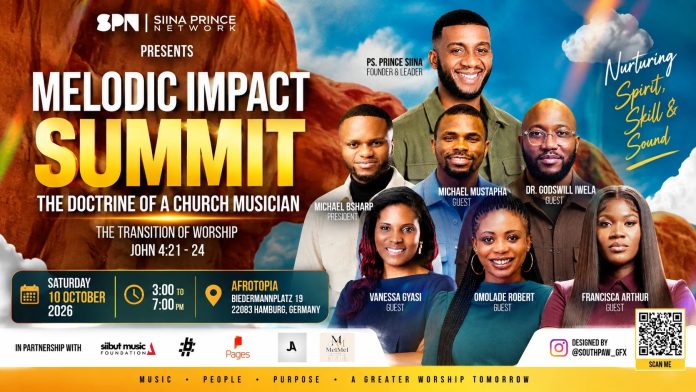
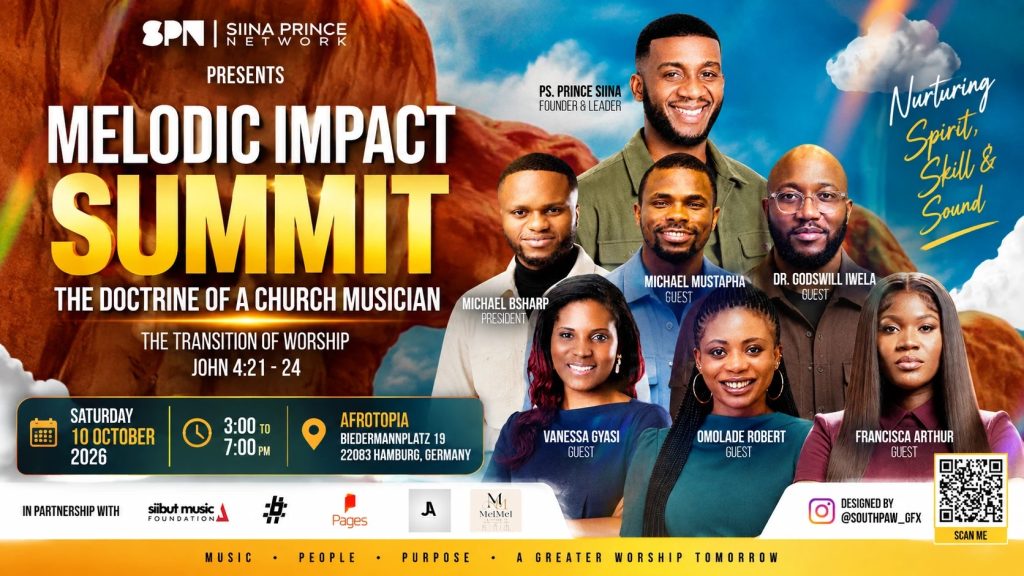
SiinaPrinceNetwork (SPN) is set to bring the Melodic Impact Summit 2026 to Hamburg, Germany, on Saturday, October 10, with a programme designed to challenge church musicians and worship leaders to look beyond performance and examine the spiritual responsibility behind their ministry.
SPN Brings Melodic Impact Summit to Hamburg, Germany 3
The summit, themed “The Doctrine of a Church Musician”, will focus on “The Transition of Worship”, with John 4:21–24 serving as its central Scripture.
The event announcement has also been published independently by Kumikasa, corroborating the date, theme, speakers, venue and programme details supplied for the event.
From Sound to Spiritual Responsibility
According to SPN, music ministry is more than producing sound. It involves the person behind the song, the calling behind the instrument and the responsibility attached to leading others in worship.
Founded and led by Pastor Siina Prince, with Michael Bsharp serving as President, SPN describes itself as a non-denominational music ministry network committed to “Nurturing Spirit, Skill & Sound.”
The Melodic Impact Summit is held twice a year and brings together musicians, worshippers, music directors and ministers for worship, teaching, connection and reflection.
The Hamburg edition will examine the biblical development of worship from the altar and covenant through the Tabernacle, priesthood and Davidic worship, while also considering prophetic correction, Christ, the Holy Spirit and worship surrounding God’s throne.
Three Sessions
1. Panel Discussion — Leadership, Relationships & the Musician
The opening session will address the human and leadership realities behind music ministry.
Topics will include leadership and responsibility, personal integrity, healthy boundaries, conflict resolution, interpersonal relationships, team culture, spiritual maturity and accountability.
The session is designed to encourage musicians and leaders to build healthier teams while serving faithfully.
2. Worship Experience — From Performance to Presence
The second session will move from conversation into worship.
SPN says the worship experience will encourage participants to move away from the pressure of performance and return to the heart of worship.
The emphasis will be on making Christ the centre rather than making the musician the centre.
3. Teaching — The Transition of Worship
The final session will explore the development and transformation of worship throughout the biblical narrative.
The teaching will examine how worship has transitioned across different biblical seasons while remaining centred on God’s presence, holiness and glory.
Speakers and Invited Voices
Pastor Siina Prince and Michael Bsharp will be joined by invited voices including Michael Mustapha, Dr. Godswill Iwela, Vanessa Gyasi, Omolade Robert and Francisca Arthur.
The event is expected to bring together people with different experiences in music, ministry and leadership for a deeper conversation about the calling of the church musician.
At the heart of the summit is a message that excellence and spirituality should not be separated.
Not simply how we sound, but what our sound carries.
Not merely performance, but presence.
Not just music, but ministry.
SPN Brings Melodic Impact Summit to Hamburg, Germany 4
Event Details
Event: Melodic Impact Summit 2026 Theme: The Doctrine of a Church Musician Focus: The Transition of Worship Scripture: John 4:21–24 Date: Saturday, October 10, 2026 Time: 3:00 PM–7:00 PM Venue: Afrotopia, Biedermannplatz 19, 22083 Hamburg, Germany Organiser: SiinaPrinceNetwork (SPN)
GhanaMedia.net encourages readers attending or sharing the event to rely on the organisers’ official channels for any last-minute changes to programme or venue arrangements.
Follow GhanaMedia on X: @GhanaMedia123 for more Ghanaian and African stories, culture, faith and community updates.
Digital Finance Must Move Ghanaians Beyond Basic Transactions — MMFL
MobileMoney Fintech executive Abdul-Razak Issaka-Ali says Ghana’s next phase of financial inclusion should help customers save, invest, access credit and build stronger financial futures.
Ghana’s next phase of financial inclusion must move beyond simply sending and receiving money to help more people save, invest, access credit, obtain insurance and build stronger financial futures, according to Abdul-Razak Issaka-Ali, Chief Commercial Operations Officer of MobileMoney Fintech Ltd (MMFL).
Digital Finance Must Move Ghanaians Beyond Basic Transactions — MMFL
Speaking at the launch of MTN Ghana’s 2026 DigiFest at MTN House in Accra on September 7, Issaka-Ali said the next frontier of digital finance was to translate widespread access to mobile financial services into everyday financial value and improved financial wellbeing.
His comments form part of a broader DigiFest 2026 programme focused on digital innovation, technology and practical solutions for Ghana’s digital economy.
From Transactions to Financial Wellbeing
According to Issaka-Ali, mobile money has played an important role in expanding financial inclusion by making it easier for Ghanaians to move money and access financial services.
But he argued that financial inclusion should not stop at the ability to conduct a transaction.
“Financial inclusion should not end with being able to make a transaction.”
He said there was significant room to deepen access to savings, credit, investments, insurance, pensions and other financial products.
The objective, he explained, should be to give customers tools that help them manage risk, plan for the future and pursue new economic opportunities.
The comments build on Issaka-Ali’s earlier public advocacy for expanding digital financial services beyond payments. In June, he said digital transaction histories were increasingly helping small businesses demonstrate creditworthiness and potentially improve access to finance.
Collaboration Needed for a Cash-Lite Economy
Issaka-Ali also stressed that Ghana’s transition toward a more digitally enabled, cash-lite economy cannot be driven by mobile money operators alone.
He called for continued collaboration among mobile money operators, banks, insurance companies, pension providers, fintech companies, regulators and other players within the financial ecosystem.
“A cash-lite economy cannot be delivered by MoMo alone.”
He said MMFL’s platform approach was designed to enable partners to make a broader range of financial products available to customers.
The MoMo App, he added, provides a channel through which users can discover, access and manage multiple financial and lifestyle services.
AI and APIs Could Deepen Digital Finance
The MMFL executive also highlighted the potential of emerging technologies to improve digital financial services.
He pointed to artificial intelligence (AI) and application programming interfaces (APIs) as technologies that could help financial institutions personalise services, connect products more efficiently, respond more quickly to customers and strengthen fraud detection and prevention.
For Ghana’s digital-finance ecosystem, this represents a shift from simply digitising existing transactions toward building more integrated financial services around customers’ everyday needs.
MoMo FinTech Lab
The discussion also comes as MMFL expands its support for homegrown fintech innovation through the MoMo Fintech Lab.
The programme is designed to identify, support and develop innovative fintech ideas with the potential to contribute to the future of financial services in Ghana.
The programme offers selected participants mentorship, skills development, technical support, stakeholder engagement, networking and pitching opportunities. Its selection process includes stages such as hackathons, mentorship and final demonstrations.
The initiative is open to students, developers, entrepreneurs, startups and innovators working on solutions capable of addressing everyday challenges and expanding financial access.
Innovation Must Solve Real Problems
For Issaka-Ali, however, technological advancement should ultimately be measured by its impact on customers.
“The goal is not technology for its own sake.”
He said technology and partnerships should be used to solve real customer needs, expand opportunity and help more Ghanaians build healthier financial lives.
That message aligns with the broader objective of DigiFest 2026, where MTN Ghana has positioned digital innovation around practical solutions and improved customer experiences rather than technology for its own sake.
As Ghana’s digital financial ecosystem continues to expand, the challenge will increasingly be whether access to digital platforms translates into meaningful improvements in household financial resilience, business growth and long-term financial security.
GHANAMEDIA EDITORIAL NOTE: The statements attributed to Abdul-Razak Issaka-Ali are based on the corporate release supplied to GhanaMedia and independently corroborated reporting on his DigiFest remarks. The broader DigiFest and MoMo Fintech Lab context has also been verified through independent Ghanaian reporting and MTN Ghana’s published programme information.
GhanaMedia has retained attribution where statements represent MMFL’s views, projections or strategic objectives rather than independently established outcomes.
For more verified Ghanaian business, technology and financial news, follow @GhanaMedia123 on X.
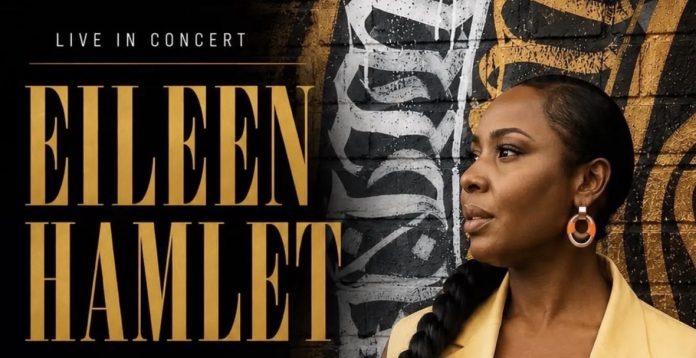
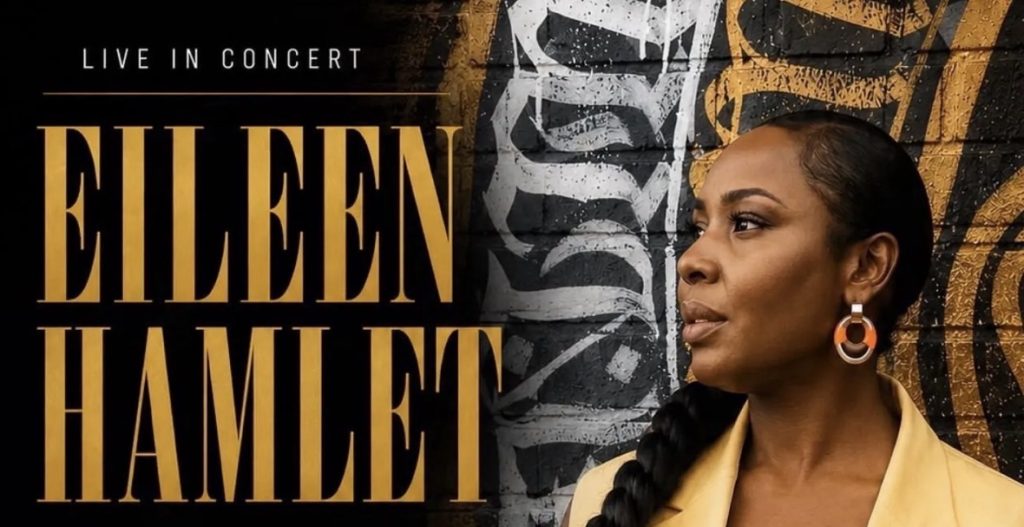
Hamburg-based singer and songwriter Eileen Hamlet is set to celebrate her 40th birthday with an intimate live concert and Spotify release event in Hamburg on Friday, September 18, 2026.
The event, titled “Eileen Hamlet – Birthday & Spotify Release Concert,” is scheduled for 7:30 p.m. at Dee Loung Hamburg, Mundsburg Center, according to the Eventfrog listing.
Eileen Hamlet Celebrates Birthday With Concert and Spotify Release in Hamburg 8
A Night of Music and Celebration
In a personal invitation shared with friends and supporters, Hamlet described the occasion as a special birthday celebration combining live music, good vibes and an intimate gathering.
“I can’t believe it, but I’m turning 40!” she wrote in the invitation.
The promotional material for the event describes the evening as featuring Eileen Hamlet & Live Band, with a musical blend encompassing Afro Soul, R&B and inspirational music.
The celebration will also coincide with a Spotify release, adding a new chapter to Hamlet’s musical journey.
Eileen Hamlet Celebrates Birthday With Concert and Spotify Release in Hamburg 9
Ghanaian Roots, Hamburg Music Scene
Hamlet has previously been described by Hamburg cultural organisations as a singer with Ghanaian roots, whose music combines elements of soul, modern R&B, Afrobeats and gospel.
Her work includes songs and lyrics in English, German and Twi, while her performances have connected her with Hamburg’s wider cultural and music scene.
For Eileen Hamlet, the evening represents more than a birthday celebration. It brings together music, personal milestones, cultural identity and a new musical release in an intimate Hamburg setting.
GhanaMedia.net wishes Eileen Hamlet a happy 40th birthday and a successful Spotify release.
For more Ghanaian and African stories from Germany and beyond, follow Ghana Media on Facebook.
Why Ghana Must Level the Playing Field for Children From Deprived Communities
Benjamin Teye Larweh reflects on scoring aggregate 08 in 1995 while studying under severe educational disadvantages—and asks whether Ghana’s school-placement system truly delivers fairness.
By Benjamin Teye Larweh, The Nobi Boy
In 1995, I completed my basic education at Samlesi Amanga L/A JSS with an aggregate of 08.
At the time, it was a remarkable achievement. My result was reportedly the best among the surrounding villages and towns. What makes the achievement even more significant to me is that it took almost 30 years before another student from the area could break that record.
OPINION | EDUCATION & EQUITY 11
But there is another side to that story.
Despite obtaining an aggregate of 08, I was refused admission to Pope John’s Secondary School, the school I had hoped to attend.
Looking back three decades later, I have come to appreciate that my experience was not merely about one boy missing out on one school. It reflected a much bigger problem in Ghana’s education system: we have often expected children from vastly unequal circumstances to compete as though they started from the same position. They do not.
I Did Not Study Under the Same Conditions
Throughout my basic education, there was no electricity in my village, Nobi Yorkornor.
I studied with lanterns.
When night fell, while children in towns and cities could sit under electric lights and study, my reality was different. The lantern was my source of light.
Getting to school was another challenge. I had to walk several kilometres to attend classes.
Throughout my basic education, the only time I saw examination questions printed on paper was during our JHS 3 mock examinations, barely four months before the BECE.
Before then, our examination questions were written on chalkboards and deleted immediately to make way for the next subject.
Think about that.
A child preparing to compete in a national examination had hardly experienced the examination environment that other children encountered routinely.
Yet, on examination day, we were all placed on the same starting line.
Or, more accurately, we were told that we were on the same starting line.
We were not.
Equality Is Not Always Fairness
There is an important distinction between equality and equity.
Equality says: Give every child the same opportunity.
Equity asks a more difficult question: What must we do to ensure that children who start from significantly disadvantaged circumstances have a genuinely fair opportunity to compete?
A child in a well-resourced school may have electricity, computers, textbooks, internet access, trained teachers, extra classes, mock examinations and exposure to examination formats from an early age.
Another child in an underserved community may walk several kilometres to school, study under a lantern, share limited textbooks with several classmates and have little or no exposure to computers.
Then both children sit the same examination.
We call this equality.
But is it fairness?
This is the question Ghana must confront.
The Problem Has Not Disappeared
Thirty years after my BECE, technology has transformed the way students are assessed and placed into Senior High Schools.
The Computerized School Selection and Placement System has introduced significant efficiencies into the placement process and has recently been upgraded to allow parents and guardians to complete parts of the admission and enrolment process online.
But technology, by itself, does not necessarily guarantee equity.
In fact, if we are not careful, technology can make existing inequalities less visible.
A computerized system can process thousands of candidates with impressive speed. It can apply rules consistently. It can reduce some forms of human interference.
But a computer does not know that one child studied under electricity while another studied under a lantern.
It does not know that one candidate had access to computers for years while another may not have encountered a computer at all before the examination.
It does not know that one child walked five kilometres to school every morning while another was driven to school.
It sees grades. It processes choices. It applies algorithms.
But children are more than numbers.
Should a Rural Child Be Penalised for Being Born in a Deprived Community?
This is not an argument for lowering academic standards.
Neither is it a call for unqualified students to be admitted into elite Senior High Schools.
It is a call for Ghana to recognise that academic performance is produced within social and educational environments.
If two children achieve the same aggregate but one has done so despite significantly fewer educational resources, should the system at least be capable of recognising that circumstance?
If a brilliant child from a deprived community narrowly misses the cut-off for a highly competitive school because of the structural disadvantages surrounding his or her education, should there be no mechanism to identify and support that child?
These are difficult questions. But they deserve serious national discussion.
We Need a Deprivation-Sensitive Placement System
Ghana should consider developing mechanisms within the SHS admission and placement framework that recognise students from demonstrably deprived educational environments.
Such a mechanism could consider:
The location and deprivation status of the student’s basic school;
Availability of electricity and digital learning facilities;
Teacher availability and school resources;
Distance travelled to school;
Access to textbooks and learning materials;
Historical academic performance of the school;
Socio-economic conditions within the community; and
The student’s individual academic performance.
The purpose should not be to give rural children an unfair advantage. The purpose should be to prevent structural disadvantage from becoming a permanent educational sentence.
We Must Also Invest Before the Placement Stage
The bigger solution, however, must begin long before BECE results are released.
If we genuinely want equal opportunity, then children in deprived communities must receive comparable educational resources.
We need electricity in every school. We need functional libraries. We need laboratories. We need computers and reliable internet connectivity. We need qualified and motivated teachers. We need regular mock examinations and exposure to examination formats. We need reading programmes. We need strong guidance and counselling.
And where communities are extremely remote, we must find innovative ways of reducing the distance children travel to school.
The ultimate objective should be to eliminate the disadvantage—not merely compensate for it at the point of admission.
My Story Is Not About Me
I sometimes look back at that 1995 result and wonder what would have happened if the circumstances had been different.
What if I had studied under electricity? What if I had regular access to textbooks? What if I had been exposed to printed examination papers long before sitting the BECE? What if I had attended a well-resourced school?
What if the admissions authorities had understood the context in which I achieved aggregate 08?
I will never know.
But I do know this:
There are thousands of children in Ghana today who are living my 1995 story. They are intelligent. They are hardworking. They are ambitious. They are capable of excelling. But they are competing against children who have had educational opportunities that they simply have not had.
We cannot continue pretending that the competition is entirely fair simply because everybody eventually sits the same examination.
Let Us Not Allow a Child’s Geographical Location to Determine His or Her Destiny
A child’s potential should not be determined by whether he or she was born in Accra, Kumasi, Takoradi or a small village such as Ahinkwa that many Ghanaians have never heard of.
A child should not be disadvantaged because his or her community does not have electricity. A child should not be less competitive because his or her school lacks computers. A child should not be made to pay for circumstances over which he or she has absolutely no control.
And most importantly, a child’s geographical location should not become a proxy for his or her intellectual ability.
My aggregate 08 in 1995 was not achieved because the circumstances were favourable.
It was achieved despite the circumstances.
That distinction matters.
Today, as Ghana continues to refine its computerized SHS placement system, we have an opportunity to ask a fundamental question:
Are we merely placing students efficiently, or are we placing them fairly?
Efficiency is important. Transparency is important. Merit is important. But equity is equally important.
The children of deprived communities do not need sympathy. They need opportunity. They do not need standards to be lowered for them. They need the barriers standing between their ability and opportunity to be recognised and addressed.
Thirty years ago, I was the Nobi Boy who scored aggregate 08 but was refused admission to my first-choice school.
Today, I speak for similar Nobi Boys and Nobi Girls across the country who are still sitting under lanterns, walking long distances to school and dreaming of entering Ghana’s best Senior High Schools.
Let us build a system in which where a child comes from does not determine how far that child can go.
That is not favouritism. That is educational justice.
Benjamin Teye Larweh The Nobi Boy
GHANAMEDIA EDITORIAL NOTE: GhanaMedia welcomes evidence-based public debate on education, equity and the future of Ghana’s children. The author’s personal experiences are presented as his account, while the broader concerns about educational inequality and the current placement system are supported by independent reporting and institutional evidence.
GhanaMedia also notes that the Ghana Education Service formally identifies equity, inclusion and special attention to children in deprived areas among its educational objectives.
For more verified Ghanaian and international news, follow @GhanaMedia123 on X.
Strika Reportedly Sentenced Over Kwashieman Footbridge Case as Jail Term Remains Disputed
The former Beasts of No Nation actor reportedly told a former caretaker he received a one-year prison sentence, while other reports have claimed seven years.
Ghanaian actor Emmanuel Nii Adom Quaye, popularly known as Strika, has reportedly been sentenced following the widely circulated Kwashieman footbridge incident involving the alleged removal of metal railings.
DEVELOPING — SENTENCING REPORTED; JAIL TERM DISPUTED 13
Strika gained international recognition for portraying the character Strika in the 2015 Netflix film Beasts of No Nation.
Reports of the sentencing emerged on Monday, September 14, 2026, weeks after footage circulated online appearing to show Strika being confronted by residents at the Kwashieman footbridge in Accra over allegations that he was removing metal components from the structure, reportedly for scrap.
Earlier reports said a police officer arrived at the scene and accompanied Strika for further investigations. At the time, the allegations had not been independently established.
Conflicting reports over sentence
The precise length of the reported prison sentence is currently unclear.
A report published by Pulse Ghana on September 14, 2026 said Strika reportedly told his former caretaker, Official Gunshot GH, during a telephone conversation that he had appeared before a court and received a one-year prison sentence. He reportedly said he was expected to be transferred to Nsawam Prison.
However, other reports circulating on Monday claimed that the actor had been sentenced to seven years in prison.
Importantly, the discrepancy has not yet been independently clarified. GhanaMedia therefore cannot responsibly present the seven-year figure as established fact at this stage.
The case attracted widespread attention
The incident generated considerable public discussion because of Strika’s history as a child actor who achieved international recognition at a young age.
His situation has also prompted calls for compassion and greater attention to his personal circumstances. Actress Ama K. Abebrese recently appealed for prayers and support for the actor and urged the public not to compare his life with that of his former Beasts of No Nation co-star Abraham Attah.
The case has consequently developed beyond the original footbridge allegation, reigniting debate about the long-term welfare of young performers after achieving early fame.
GhanaMedia’s verification position
At the time of publication, GhanaMedia can verify that multiple reports are now describing a court sentence involving Strika, but the exact duration of that sentence remains disputed in publicly available reporting.
GhanaMedia will update this report if an official court record, Ghana Police Service statement or other authoritative judicial source establishes the exact sentence.
GhanaMedia follows a strict verification principle: where credible reports conflict on a material fact, we identify the conflict rather than presenting one version as settled fact.
For more verified Ghanaian and international news, follow @GhanaMedia123 on X.
KRIF Ghana Limited is launching its first Procurement Masterclass to help organisations make purchasing decisions based on total value rather than price alone.
Accra, September 11, 2026 — KRIF Ghana Limited is championing a more strategic approach to organisational procurement with the launch of its first-ever Procurement Masterclass 2026, designed to help businesses and institutions make purchasing decisions based on value rather than price alone.
KRIF Ghana Champions Smarter Procurement With First-Ever Masterclass 16
The masterclass is scheduled for Wednesday, September 30, 2026, at Standard Height by Cleaver House, 42 Sekou Toure Street, Accra, beginning at 8:00 a.m.
It will be held under the theme:
“Buying Better: Cost, Quality, Risk & Total Value in Workplace Procurement.”
Moving Beyond the Lowest Price
At the heart of the programme is the idea that the cheapest quotation does not necessarily represent the most economical procurement decision.
Participants will examine the concept of total cost of ownership, considering not only the initial purchase price but also consumables, maintenance, downtime, operational performance and eventual replacement costs.
KRIF Ghana Champions Smarter Procurement With First-Ever Masterclass 17
The masterclass will also examine supplier risk, including how organisations can assess reliability, warranty coverage, after-sales service, product authenticity, availability and supplier capacity before committing resources.
Practical Procurement Learning
KRIF said the programme will go beyond conventional lecture-based training.
Participants will work through procurement case studies, group exercises, simulations and real-life organisational scenarios designed to demonstrate how procurement decisions can affect institutional performance.
Sessions will include:
Beyond the Lowest Price
The Hidden Cost of Cheap
Procurement Without Regret
Live Procurement Challenge
Procurement Challenge Lab
The Procurement Challenge Lab will require participants to work through realistic procurement problems from planning through to contract award.
Promoting Value, Transparency and Accountability
KRIF Ghana said the initiative is intended to strengthen professionals’ ability to plan, manage, evaluate and monitor procurement processes while promoting value for money, transparency, accountability, fair supplier selection, efficiency, ethical conduct and effective contract management.
The focus comes at a time when procurement is increasingly being treated as a strategic function rather than simply an administrative purchasing activity.
Ghana’s Public Procurement Authority is also running a broad 2026 procurement training programme covering areas including tender preparation and evaluation, contract administration, specifications, procurement audits and the Ghana Electronic Procurement System.
Recent procurement-sector discussions have similarly highlighted the need to balance cost savings with broader value creation, supplier resilience, sustainability, risk management, ethical sourcing and long-term performance.
Free Participation
According to KRIF Ghana Limited, the masterclass is fully sponsored by the company, making participation free for attendees.
Interested participants can contact the organisers on:
0244-681997
About KRIF Ghana Limited
Established in 1986 and formally incorporated in 1993, KRIF Ghana Limited is a Ghanaian enterprise with experience spanning office equipment, stationery, money-handling technology, security solutions and institutional supply.
The company has subsequently expanded its interests and capabilities into areas including technology, media, social impact and cybersecurity while maintaining a focus on quality, reliability, innovation and customer satisfaction.
The September 30 masterclass represents KRIF’s latest initiative to contribute to professional development and smarter procurement practices in Ghana.
📲 Stay Connected With GhanaMedia.net
Get business news, corporate developments and important Ghanaian stories as they happen. Follow GhanaMedia.net on X: @GhanaMedia123.
Angelina Naa Adorkor survived the deadly Ofankor Barrier crash but suffered traumatic injuries that resulted in the amputation of both legs below the knees.
Editorial Label: VERIFIED — SUPPORT APPEAL CONFIRMED
A 12-year-old girl who survived the deadly Ofankor Barrier road crash is facing a long road to recovery after losing both legs in the devastating collision.
The survivor, identified in multiple reports as Angelina Naa Adorkor, was among those caught in the multi-vehicle crash along the Ofankor Barrier stretch of the Accra–Kumasi Highway on August 13, 2026.
12-Year-Old Ofankor Crash Survivor Loses Both Legs as Family Appeals for Help 19
According to reports, Angelina had been travelling with her ailing father to the morgue, where the body of her recently deceased mother was being kept, when tragedy struck.
Her father was killed in the crash.
Angelina sustained severe injuries that resulted in the amputation of both legs below the knees. She also suffered serious injuries to both arms and required emergency surgery and blood transfusions at Ga East Municipal Hospital.
Doctors treating her said she arrived at the hospital in critical condition and required extensive medical attention because of the severity and contamination of her injuries.
She is also receiving psychological support as she comes to terms with the loss of her parents and the trauma of the crash.
Reports say she has repeatedly asked for her father without yet knowing that he died in the accident.
Family Appeals for Support
Angelina’s aunt, Sandra, has appealed to the government, corporate organisations and members of the public to help support the girl’s treatment, rehabilitation and eventual reintegration into school and society.
Media General, through 3Foundation, has also appealed for financial support for Angelina.
According to the published appeal, contributions can be made through:
3Foundation Mobile Money: 0597433110 Reference: Ofankor
Anyone intending to donate should independently confirm the payment details with the named organisation before sending funds.
The Ofankor Crash
The August 13 crash was one of the deadliest road crashes reported in the Greater Accra Region this year.
The Ghana Police Hospital confirmed 12 deaths, while the National Road Safety Authority reported that 22 people were injured.
The collision involved two tipper trucks, two Sprinter buses, two saloon cars and a tricycle.
The NRSA has been investigating the circumstances surrounding the crash. Preliminary information indicated that a broken-down tricycle may have contributed to a chain of vehicles stopping on the road before the subsequent collision, although investigations were ongoing.
The incident has renewed concerns about road safety along the Ofankor–Pokuase corridor, which authorities have identified as a crash-prone stretch.
For Angelina, however, the focus now is recovery.
At just 12 years old, she faces the challenge of rebuilding her life after losing both legs and both parents in a single devastating period.
Her family’s appeal is for support to help her receive the care, rehabilitation and assistance she needs to continue her education and rebuild her future.
📲 Stay Connected With GhanaMedia.net
Get breaking news, verified stories and important updates as they happen. Follow GhanaMedia.net on X at @GhanaMedia123.
A dramatic hypothetical scenario puts seven prominent African and global leaders in the same crisis — and asks one difficult question: who would you save?
Imagine a crisis at sea.
A rescue boat approaches a group of world leaders struggling in dangerous waters, but there is one devastating limitation: the boat can save only two people.
If You Could Save Only Two World Leaders, Who Would You Choose? 21
That is the provocative scenario presented in this GhanaMedia.net graphic, featuring seven prominent African and global political figures.
The question is deliberately uncomfortable:
If you had the power to save only two, who would you choose — and why?
The graphic features:
Bola Ahmed Tinubu — Nigeria
John Dramani Mahama — Ghana
Donald Trump — United States
Vladimir Putin — Russia
Félix Tshisekedi — Democratic Republic of Congo
Cyril Ramaphosa — South Africa
William Ruto — Kenya
This is not a real rescue situation and should not be interpreted as a prediction or report of an actual event. It is a hypothetical political debate designed to explore how people judge leadership, national interests, economic potential, diplomacy, security and international influence.
Several of the African leaders featured also hold prominent responsibilities within the African Union’s continental agenda. The AU identifies John Dramani Mahama, Bola Ahmed Tinubu, Félix Tshisekedi, Cyril Ramaphosa and William Ruto among its current champion heads of state on different continental priorities. African Union
That makes the hypothetical even more interesting: would you make your choice based on your own country’s interests, Africa’s interests, global influence, economic leadership, military power, diplomacy or simply the leader you believe has the greatest potential to make a difference?
There is no objectively correct answer.
Someone may choose a leader because of economic policy. Another person may prioritise peace and diplomacy. Someone else may consider military strength, technological advancement or international influence.
And personal political loyalties could dramatically influence the decision.
Now the question goes to you
If you were on that rescue boat and could save only TWO, who would you save?
Bola Ahmed Tinubu — Nigeria
John Dramani Mahama — Ghana
Donald Trump — United States
Vladimir Putin — Russia
Félix Tshisekedi — DR Congo
Cyril Ramaphosa — South Africa
William Ruto — Kenya
Choose TWO — and give us your reason.
The real debate isn’t necessarily about the individuals.
It is about what qualities people believe matter most in a leader when the stakes are extremely high.
📲 Stay Connected With GhanaMedia.net
Get breaking news, verified stories and thought-provoking discussions as they happen. Follow GhanaMedia.net on X: @GhanaMedia123.
President John Dramani Mahama says the National Cathedral should not be financed with taxpayers’ money, arguing that Christians could collectively mobilise the funds needed to complete the project.
President John Dramani Mahama has suggested that Christians in Ghana could contribute GH¢1,000 each towards the construction of a National Cathedral rather than relying on taxpayers’ money to finance the project.
Mahama: Christians Can Contribute GH¢1,000 Each to Build National Cathedral 23
Mahama made the remarks during a citizens’ engagement in Wa as part of his Resetting Ghana Tour.
Explaining his position on the controversial project, the President said he had no objection to Ghana having a National Cathedral but maintained that public funds should not be used to finance its construction.
“If we all pay 1,000 cedis each, we should be able to construct a national cathedral.”
He argued that Ghana’s Christian community has sufficient numbers to mobilise the resources required and suggested that Christian organisations outside Ghana could also contribute.
Not a Mandatory GH¢1,000 Payment
The President’s comment does not amount to an announcement of a GH¢1,000 government charge or mandatory contribution on Christians.
Rather, Mahama was presenting voluntary contributions as a possible alternative funding model for the National Cathedral.
His central argument was that taxpayers’ money should not be used to finance the project.
Mahama Says National Cathedral Was Not a National Policy
Mahama also explained why his administration has not treated the National Cathedral like other projects inherited from the previous government.
According to him, the National Cathedral was a personal pledge made by former President Nana Akufo-Addo to God, rather than a national policy that his administration was obligated to continue.
He nevertheless stressed that he was not against the construction of a National Cathedral.
Concerns Over the Location
The President renewed his concerns about the location of the proposed cathedral.
He pointed to the concentration of major public facilities in the area, including Parliament, the International Conference Centre, the Greater Accra Regional Hospital and the National Theatre.
Mahama argued that placing another major facility in the area could create congestion, particularly during major national events.
Demolished Properties Also Raise Concerns
Mahama further criticised the destruction of properties that occurred during preparations for the project.
He mentioned the demolition of 10 judges’ residences, the residence of the Malian Ambassador and the old passport office, among other properties.
The President questioned the extent of the destruction and said some of the affected properties had not been replaced.
Forensic Audit Completed
President Mahama also disclosed that a forensic audit of the National Cathedral project has been completed and is currently with the Attorney-General.
He said a copy would be made available to the Christian Council of Ghana so that it could examine how almost US$90 million associated with the project was spent and determine whether corrective action is necessary.
Christian Council Forms Technical Committee
The disclosure comes amid renewed discussions about the future of the stalled National Cathedral project.
The Christian Council of Ghana recently established a technical committee to examine possible funding arrangements, the location and other outstanding issues surrounding the project.
The committee has been given one month to make recommendations on the way forward.
GhanaMedia Verification
VERIFIED — PRESIDENTIAL REMARK CONFIRMED.
President Mahama did make the GH¢1,000 contribution remark.
However, the statement should not be reported as a new compulsory payment or government directive requiring Christians to pay GH¢1,000.
It was presented by the President as a possible voluntary funding approach to avoid using taxpayers’ money for the National Cathedral.
Stay Connected With GhanaMedia.net
For breaking news, verified stories and important developments from Ghana and Africa, follow GhanaMedia.net on X (@GhanaMedia123) and stay ahead of the news.
The Ministry of Foreign Affairs is seeking relatives of 40-year-old Stephen Kofi Boamah, a Kumasi-born Ghanaian whose body was found in an apartment in Berlin, Germany.
Editorial Label: VERIFIED — OFFICIAL FOREIGN MINISTRY APPEAL
Ghanaian Found Dead in Berlin
The Ghana Ministry of Foreign Affairs has appealed to the public for help in tracing the relatives of a Ghanaian man whose body was found in an apartment in Berlin, Germany.
Ghana Foreign Ministry Appeals for Family of Ghanaian Found Dead in Berlin 25
The deceased has been identified as Stephen Kofi Boamah, who was born on February 8, 1986, in Kumasi, Ghana. He was 40 years old and was reportedly known within parts of Berlin’s Ghanaian community by the nickname “Gully.”
Foreign Ministry Issues Public Appeal
The Ministry issued the appeal on September 11, 2026, asking anyone with information about Boamah or his relatives in Ghana to come forward.
According to the Ministry, the information will assist authorities in formally notifying his relatives of his death and facilitating the necessary arrangements concerning his remains.
The appeal is also directed at people who may have known Boamah during his time in Ghana or through Ghanaian community networks in Germany.
How to Help Trace His Family
Anyone with information about Stephen Kofi Boamah or his relatives can contact the Ghana Ministry of Foreign Affairs through the following channels:
Ghana Mission in Berlin Telephone: +49 (0)30 547 149-0 Email: [email protected]
What GhanaMedia Has Verified
Stephen Kofi Boamah was born in Kumasi, Ghana.
He was 40 years old.
His body was found in an apartment in Berlin, Germany.
He was reportedly known as “Gully” within sections of Berlin’s Ghanaian community.
Ghana’s Ministry of Foreign Affairs has officially appealed for help locating his relatives.
The Ministry is seeking his family so they can be formally notified and arrangements can be made concerning his remains.
No Cause of Death Confirmed
GhanaMedia has found no reliable official information establishing the cause of Stephen Kofi Boamah’s death.
We therefore will not speculate about the circumstances surrounding his death or suggest foul play without credible evidence.
A Message to the Ghanaian Diaspora
This is an urgent appeal to Ghanaians in Germany and members of the wider Ghanaian diaspora who may have known Stephen Kofi Boamah or have information about his family.
Anyone with credible information is encouraged to contact the Ghana Ministry of Foreign Affairs or the Ghana Mission in Berlin using the official contact details provided above.
Stay Connected With GhanaMedia.net
For breaking news, verified stories and important developments affecting Ghanaians at home and abroad, follow GhanaMedia.net on X (@GhanaMedia123) and stay ahead of the news.